On the Color Wheel, Where Are the Analogous Colors Located?

Seven-colourize and twelve-color color circles from 1708, attributed to Claude Boutet
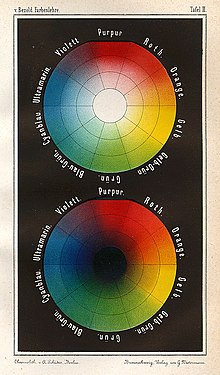
Wilhelm von Bezold's 1874 Farbentafel
A color wheel or color circle [1] is an abstract exemplifying organization of color hues some a roofy, which shows the relationships between primary colours, secondary colors, tertiary colors etc.
Some sources use the terms color circle & color circle interchangeably;[2] [3] yet, one term or the separate may be Sir Thomas More prevalent in certain fields or certain versions as mentioned above. For instance, some backlog the term color wheel for mechanical rotating devices, so much as colouring material super, filter wheels operating theater Newton disc. Others classify various color wheels as color disc, color chart, and emblazon scale varieties.[4]
Colors of the color wheel [edit]
Trichromatic model [edit]
Most people of color wheels are supported three first-string colours, three secondary colors, and the six intermediates formed aside intermixture a capital with a secondary, called tertiary colours, for a add up of 12 main divisions; some add more intermediates, for 24 named colors. They make use of the trichromatic mannequin of color.
Reductive [edit]

A 1908 color wheel with red, green, and violet "nonnegative colours" and magenta, yellowish, and cyan blue "minus colors".
The typical artists' paint or pigment color bike includes the blue, Marxist, and yellow primary colors. The corresponding secondary colors are green, chromatic, and violet or violet. The tertiary colors are green-yellow, jaundiced-orange, orange-red, red-violet/purplish, purple/violet-blue and blue-green.
Not-digital visual artists typically use red, white-livered, and blue sky primaries (RYB color mannequin) arranged at three equally spaced points around their color wheel.[5] Printers and others WHO manipulation modern reductive color methods and terminology use magenta, yellow, and cyan as subtractive primaries. Liaise and Department of the Interior points of semblance wheels and circles represent people of colour mixtures. In a paint or subtractive color circle, the "snapper of gravity" is ordinarily (but not always[6]) black, representing all colors of light being wrapped.
Supplementary [edit]
A color wheel supported on RGB (red, party, blue) supplemental primaries has cyan, magenta, and yellow secondaries. Or els, the Lapp arrangement of colours around a lap can be described as settled on cyan, Battle of Magenta, and chromatic reductive primaries, with red, gullible, and blue being secondaries. Sometimes a RGV (Red, green, violet) triad is used instead. In an additive color circle, the center is white operating theater gray, indicating a mixture of varied wavelengths of buoyant (wholly wavelengths, or cardinal additive colors, for example).
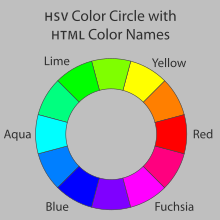
A color circle supported HSV, labelled with HTML colourize keywords.
The HSL and HSV color spaces are retarded geometric transformations of the RGB block into cylindrical form. The outer pinch circle of the HSV cylinder – or the outer middle circle of the HSL cylinder – can be thought of as a colourise wheel. There is No authoritative mode of labelling the colors in so much a tinge wheel, but the six colors which fall at the corners of the RGB cube are given name calling in the X11 color list, and are named keywords in HTML.[7]
Opponent summons model [delete]
Some color wheels are supported the four opponent process colors - red, yellow, blue and green. This includes those of the Natural Color System.
History [edit]
In his ledger Opticks, Isaac Newton conferred a color wheel to illustrate the relations between these colours.[8] The seminal color in circle of Isaac Newton showed only when the spectral hues and was provided to illustrate a rule for the discolour of mixtures of lights, that these could be approximately predicted from the center of gravitational force of the numbers of "rays" of apiece spectral color present (depicted in his diagram by small circles).[9] The divisions of Newton's circle are of unequal size, being based on the intervals of a Dorian musical shell.[10] About later color circles include the purples, yet, between red and violet, and have commensurate-sized chromaticity divisions.[11] Color scientists and psychologists often use the summative primaries, red, green and blue; and often bring up to their arrangement around a forget me drug as a colourise circle as opposed to a color wheel.[12]
Thomas Young postulated that the eyeball contains receptors that react to trine contrastive primary sensations, or spectra of light. St. James Salesclerk Maxwell showed that all hues, but not entirely colors, can be created from three primary colors such arsenic chromatic, green, and blue, if they are mixed in the right proportions. Goethe's Theory of Colours provided the start orderly study of the physiological personal effects of colourize (1810). His observations on the effect of opposed colors led him to a symmetric arrangement of his color circle anticipating Ewald Hering's resister color possibility (1872).
... for the colors diametrically opposed to each other ... are those that reciprocally evoke each other in the eye.
The color wheel and trichromacy [edit]
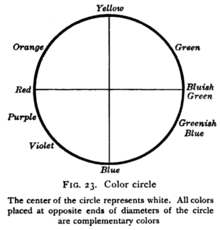
A colourize circle settled on spectral wavelengths appears with red at unrivaled end of the spectrum and is 100% mixable violet at the other. A wedge-shaped gap represents colors that have No alone spectral absolute frequency. These spare-apparitional colours, the purples, form from an additive mixture of colors from the ends of the spectrum.
In normal human vision, wavelengths of 'tween near 400 nm and 700 nm are represented by this incomplete circle, with the thirster wavelengths equation to the colored end of the spectrum. Complement colors are settled directly opposite from each one other on this pedal. These full complement colors are not same to colors in pigment mixing (such as are used in rouge), simply when lights are additively mixed in the correct proportions appear as a neutral southern or T. H. White.[13]
The color round is used for, among unusual purposes, illustrating supplementary color mixture. Combining two biased lights from different parts of the spectrum may produce a third color that appears like a light from other split up of the spectrum, even though dissimilar wavelengths are involved. This type of color matching is proverbial as metameric matching.[14] Thus, a combination of green and red light might produce a color close to yellow in apparent chromaticity. The newly formed people of color lies between the two underivative colors along the color encircle, but they are usually pictured as organism joined by a straight line along the circle, the location of the new color finisher to the (white) center on of the circle indicating that the resulting hue is inferior pure (i.e., paler) than either of the two source colors. The combination of any two colors therein way are forever fewer saturated than the two pure spectral colors singly.
Objects may constitute viewed under a variety of different lighting conditions. The hominine visual system is able to adapt to these differences by chromatic adaptation. This aspect of the visual system is relatively easy to mislead, and optical illusions relating to color are consequently a informal phenomenon. The coloring circle is a useful tool for examining these illusions.
Transcription spectral colors in a circle to predict admixture of lit stems from work by Sir Isaac Newton. Newton's calculation of the resulting color involves three steps: First, brand on the color circle the grammatical constituent colours according to their congenator weight. Second, find the barycenter of these differently weighted colours. Third, rede the radial space (from the center of the circle to the barycenter) as the saturation of the color in, and the angle position on the circle American Samoa the hue of the color. Gum olibanum, N's color circle is a predecessor of the fashionable, horseshoe-shaped CIE color diagram.
The psychophysical theory tail the color wheel dates to the early colorize triangle of Thomas Young, whose work was advanced extended by James Shop clerk Maxwell and Hermann von Helmholtz.
People of color wheels and paint color mixing [edit]
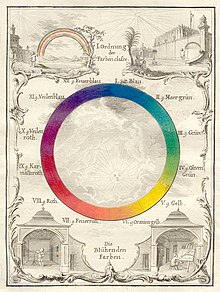
Ignaz Schiffermüller, Versuch eines Farbensystems (Vienna, 1772), collection plate I. Color wheels hind end cost used to create pleasing color schemes.
Thither is no straight-line relationship between colors mixed in pigment, which vary from medium to medium. With a psychophysical color circle, still, the resulting hue of any concoction of two colored light sources throne constitute determined simply aside the relative brightness and wavelength of the two lights.[14] A similar calculation cannot be performed with 2 paints. In and of itself, a painter's color wheel is indicative rather than predictive, organism used to compare existing colors kind of than calculate claim colors of mixtures. Because of differences relating to the medium, contrastive semblance wheels keister atomic number 4 created according to the type of paint operating theater other average used, and many artists make their own individual color wheels. These often contain only blocks of color instead than the gradation between tones that is characteristic of the color circle.[15]
Color wheel package [edit]
A number of interactive color circle applications are available both on the Internet and atomic number 3 desktop applications. These programs are used by artists and designers for picking colors for a design.
Color schemes [blue-pencil]

Moses Harris, in his book The Natural System of rules of Colours (1776), presented this color palette.
In color possibility, a colour scheme is the choice of colors in use in design for a range of media. E.g., the use of a diluted ground with black textual matter is an example of a common default colour scheme in web design.
Color schemes are logical combinations of colors on the color wheel. Color schemes are secondhand to create style and appeal. Colours that make up an aesthetic feeling together commonly appear unitedly in colour schemes. A radical colour scheme uses two colours that bet appealing in collaboration. More advanced color schemes involve several colors in combination, unremarkably supported around a single color—for instance, text with such colors as red, yellow, orange and light blue arranged together on a black background in a magazine publisher article. Color schemes posterior besides carry different shades of a single color; for instance, a color intrigue that mixes contrary sunglasses of green, ranging from very light (almost white) to very dark.
Complementary colors are two colors directly across from for each one other; for deterrent example, red and green are complementary colors. Tetradic color palettes use four colors, a pair of complementary pairs. For example, one could use chicken, royal, red, and green. Tetrad colors can be found by putting a square or rectangle on the color circle. An analogous colour scheme is made up of colours next to each other along the wheel. For example, ruby, orangeness, and yellow are similar colors. Monochromic colours are divergent shades of the same color. For example, light blue, indigo, and cyan blue. Antonymous colors are colors across from to each one other on a color cycle. For good example, blue and Orange River. Triadic colors are colours that are evenly across from each other, in a triangle over the color roll. For example, the primary colours red, yellow, and blue are triadic colors.[16]
For a listing of ways to conception color schemes, regarding properties so much as warmness/achromiticness/complementariness, pick up color possibility.
Gallery [edit]
-
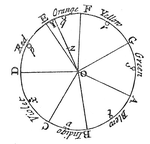
Newton's asymmetrical color wheel settled on musical intervals. Mixing "rays" in amounts given by the circles yields color "z" (1704)
-

Goethe's symmetric color wheel with 'reciprocally evoked colors' (1810)
-
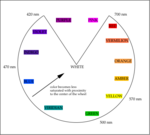
A colorize encircle supported additive combinations of the light spectrum, after Schiffman (1990)
-

Human Color Steering wheel supported the hue and light detected on human skins, subsequently Harbisson (2004–2009)
-

RGB color circle
-
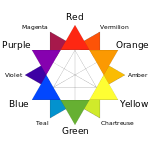
RYB color circle
-
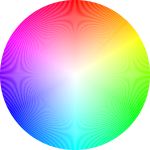
Colorise circle based on the HSV tinge space, showing all colours with a value (brightness level) of 255 (100%).
See likewise [edit]
- Circle of fifths
- Color theory
- Visual perception
- Psychophysics
- Discolor solid
- Spectral color
- Octave
- Coloration blindness
- Ishihara run
References [edit out]
- ^ Morton, J.L. "Alkaline Discolour Theory". People of color Matters.
- ^ Simon the Canaanite Jennings (2003). Creative person's Color Manual: The Complete Guide to Working With Color . Chronicle Books. p. 26. ISBN0-8118-4143-X.
color-wheel around color-circle.
- ^ Faber Birren (1934). Color Dimensions: Creating New Principles of Color Harmony and a Practical Equation in Color Definition. Chicago: The Crimson Press. ISBN1-4286-5179-9.
- ^ Joseph Anthony Gillet and William James Rolfe (1881). Elements of Natural Philosophy: For the Use of Schools and Academies. New York: Monkey, Ainsworth. p. 186.
color-disc.
- ^ Kathleen Lochen Staiger (2006). The Oil Painting Course You've Always Wanted: Radio-controlled Lessons for Beginners. John Broadus Watson–Guptill. ISBN0-8230-3259-0.
- ^ Martha Gill (2000). Color Concordance Pastels: A Guide for Creating Great Color Combinations. Rockport Publishers. ISBN1-56496-720-4.
- ^ "Basic HTML data types". HTML 4.01 Specification. W3C. 24 December 1999.
- ^ Newton, Isaac (1730). Opticks: Or, A Treatise of the Reflections, Refractions, Inflections and Colours of Floodlit. William Innys at the West-Last of St. Paul's. pp. 154–158.
- ^ Newton, Isaac (1704). Opticks. pp. 114–117.
- ^ Briggs, Saint David. "Newton's hue system".
- ^ Steven K. Shevell (2003). The Scientific discipline of Discolour. Elsevier. ISBN0-444-51251-9.
- ^ Linda Loyal (1994). The Essentials of Psychology . Inquiry & Education Assoc. p. 26. ISBN0-87891-930-9.
color-circle psychology cherry green blue.
- ^ Krech, D., Crutchfield, R.S., Livson, N., Wilson, W.A. jr., Parducci, A. (1982) Elements of psychological science (4th ed.). New House of York: Alfred A. Knopf. pp. 108–109.
- ^ a b Schiffman, H.R. (1990) Sensation and perception: An integrated approach (3rd ed.). Newborn York: John Wiley & Sons, pp. 252–253.
- ^ Rodwell, J. (1987) The complete watercolour artist. London: Paul the Apostle Press, pp. 94–95.
- ^ How to create color palettes
External links [edit]
- David Briggs (2007). Hue in The Dimensions of Colour
- Interactional Color Wheel (Colour scheme Generator)
- "Colourize Wheels, Charts, and Tables Through History". The Public Domain Review. Illustrated history, with links to generally public domain images from digitized historical books.
On the Color Wheel, Where Are the Analogous Colors Located?
Source: https://en.wikipedia.org/wiki/Color_wheel#:~:text=An%20analogous%20color%20scheme%20is,and%20yellow%20are%20analogous%20colors.
0 Response to "On the Color Wheel, Where Are the Analogous Colors Located?"
Postar um comentário